
Many agents believe their biggest business challenge is generating more leads. Jacques Ambron, CRS, isn’t convinced.
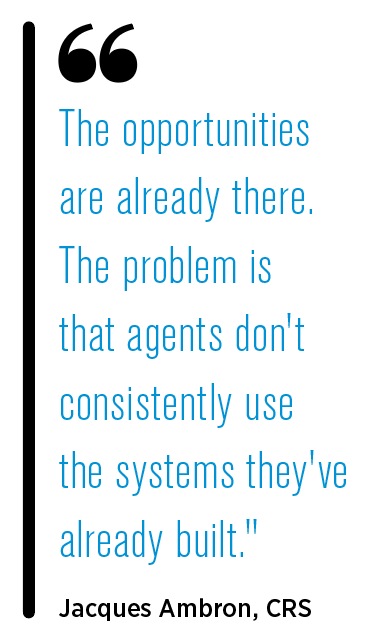
“The opportunities are already there,” says Ambron, executive vice president and managing director of sales at Brown Harris Stevens in Queens, New York. “The problem is that agents don’t consistently use the systems they’ve already built.”
For Ambron, a customer relationship management (CRM) platform isn’t simply a digital address book. It’s a daily business tool designed to make the next client conversation obvious. But that only happens when agents build habits around using it consistently.
“If you put a reminder in your CRM but don’t act on it, you’ve defeated the whole purpose,” he says.
Five Real Estate CRM Follow-Up Gaps That Cost Agents Business
A CRM doesn’t lose opportunities—people do. According to Ambron, these are the most common places where promising relationships quietly disappear.
1. No next action.
Every active contact should have a clear follow-up date attached. If a buyer says they’re planning to move in the fall, schedule the reminder immediately. Then, when that reminder appears, make the call.
Too often, agents postpone today’s follow-up until tomorrow, only to watch tomorrow’s reminders pile on top of yesterday’s.
“The idea is to act immediately,” Ambron says. “You’re already in your CRM. Reach out while you’re in that moment.”
2. Missing information.
The strength of any CRM depends on the quality of the information inside it.
Every contact should include enough detail to make future searches meaningful—not only whether someone is buying or selling, but property type, price range, preferred neighborhoods and any shared connections or affiliations that make future conversations more personal.
3. Weak categories.
Generic labels such as “warm” or “hot” aren’t enough by themselves.
Ambron categorizes contacts in multiple ways: active clients, referral sources, past clients, property preferences and shared interests. The more useful the categories, the easier it becomes to match the right people with the right opportunities.
4. Database neglect.
Even a good CRM becomes less valuable when records go unfinished or outdated.
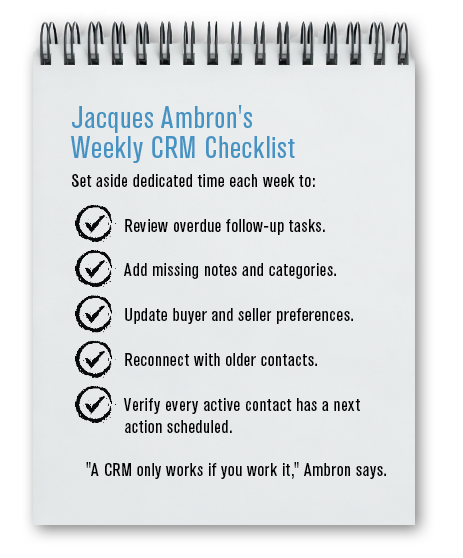
Ambron recommends blocking two to three hours each week for database maintenance, including adding missing categories, updating notes and reconnecting with contacts whose information is incomplete. Sometimes that means simply picking up the phone to learn more.
Those small improvements often uncover opportunities agents had forgotten were there.
5. Relying on memory instead of systems.
Relationships should remain personal, but remembering every follow-up shouldn’t depend on memory alone.
Automated reminders, anniversary messages and thoughtfully designed drip campaigns can keep agents consistently visible while freeing them to focus on meaningful conversations when clients are ready to engage.
Consistency Wins
One of Ambron’s favorite exercises heading into the second half of the year is reviewing the oldest contacts in the database.
Many buyers begin their search months before they’re ready to act. By the time Q4 approaches, those once-dormant prospects may now be prepared to move.
He’s seen countless agents reconnect with forgotten contacts only to discover they were actively buying or selling. In his own business, adopting disciplined CRM habits led to approximately a 30% increase in income not because he found more leads, but because he did a better job nurturing the ones he already had.
Technology alone won’t build relationships. But when paired with consistent habits, a well-maintained CRM ensures fewer opportunities slip through the cracks and more conversations turn into lasting business.