
June is more than the midpoint of the year—it’s an opportunity for a mid-year reset. For real estate agents, evaluating pipeline health, marketing performance and business systems now can create stronger momentum for the second half of the year.
For top-producing agents, the midpoint of the year is less about catching their breath and more about tightening their strategy. It’s a deliberate pause to evaluate what’s working, eliminate what isn’t and ensure you don’t leave the second half of the year to chance.
As Cherice Clark, CRS, broker-owner at Clark Premier Realty Group in Upper Marlboro, Maryland, explains, “This isn’t a check-in but a reset. A realignment. A moment to tighten the foundation before the second half of the year takes off.”
In a market that continues to shift economically, seasonally and emotionally, this kind of disciplined recalibration isn’t optional. It’s what separates consistent producers from inconsistent ones.
Why the Mid-Year Reset Matters
The real estate calendar has natural inflection points, and early summer is one of the most critical. Spring activity has revealed patterns. Pipelines are either being built or being thinned. Marketing efforts have either converted or fallen flat.
For many agents, the temptation is to push forward without looking back. But top performers do the opposite.
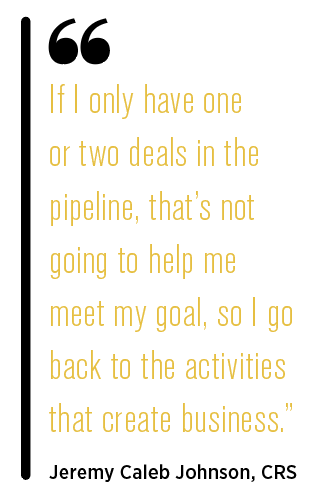
“It’s about asking, ‘Are our goals still achievable? And what needs to happen to make that happen?’” says Jeremy Caleb Johnson, CRS, associate broker at Long & Foster Real Estate in Virginia Beach, Virginia.
“That clarity is especially important in a market where external forces such as interest rates, inventory shifts and even weather events can quickly change momentum. In seasonal markets, like Door County, Wisconsin, timing alone can force a strategic pivot,” says MaryKay Shumway, CRS, broker-owner at Dwell Door County, Sister Bay, Wisconsin.
Pipeline Health: Beyond the Surface
A healthy pipeline isn’t defined by volume alone, but by visibility, something top agents achieve by pairing experience with disciplined tracking of their performance metrics, including:
- Number of active clients
- Contracts written vs. accepted
- Fallout rates and reasons
- Listing vs. buyer balance
- Time-to-close trends
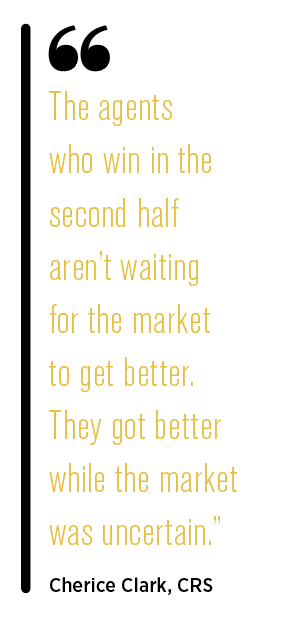
“If I’m capturing everything, I can see how many clients I’ve worked with, how much work I’ve done and how successful I was,” says Clark.
That level of detail allows agents to diagnose problems early. Are deals falling apart at inspection? Are buyers consistently losing in multiple-offer situations? Is there a gap in the listing inventory?
More importantly, it answers the most pressing mid-year question: Will this pipeline sustain production through summer and beyond?
Marketing ROI: Activity vs. Results
Mid-year is also the ideal time to separate motion from progress.
Agents are inundated with tools, platforms and “next big things.” But as Johnson points out, the industry is especially vulnerable to “shiny object syndrome,” the impulse to pursue what’s new instead of staying focused on what’s proven.
The question isn’t what you’re doing but rather what’s actually working.
For many agents, the answer is surprisingly simple: relationship-based activities.
Calls. Follow-ups. Conversations.
“The strategies that work are often the ones that feel the most routine,” Clark notes. And yet, these are the very activities agents abandon when results don’t come quickly, leading to what she calls “inconsistent results.”
Operational Reset: Tightening the System
Beyond pipeline and marketing, top producers use this time of year to refine operations.
This includes:
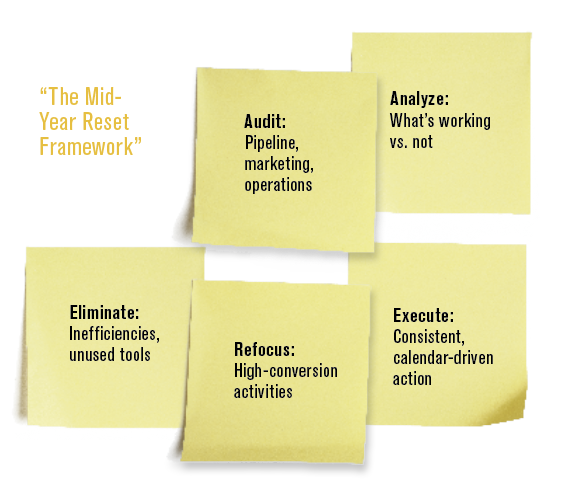
- Cleaning and updating databases
- Reviewing CRM usage and data integrity
- Automating where appropriate—but not excessively
- Reworking time-blocking schedules
- Eliminating redundant or inefficient tasks
“Having a system is one thing, but using it is another,” Clark points out.
The goal is to have a fully aligned view of what’s in front of you, supported by what you’ve done and learned. “If it’s not on the calendar, it doesn’t happen,” she adds.
That discipline extends to weekly accountability, including reviewing what was planned versus what was actually executed.
Eliminating Inefficiencies
A mid-year audit often reveals a hard truth: Many agents are busy but not necessarily productive, with inefficiencies showing up in areas such as:
- Paying for tools that aren’t used
- Repeating marketing efforts that yield no results
- Failing to follow up consistently
- Overcomplicating systems and workflows
- Chasing new strategies without mastering existing ones
Top producers address this head-on by eliminating what isn’t working, recommitting to the strategies that do and documenting their decisions to avoid repeating the same mistakes.
Strategic Adjustments for Summer
As summer approaches, strategy often shifts but not randomly.
In some markets, this means preparing for increased inventory and buyer activity. In others, it means adapting to seasonal slowdowns or unique local conditions.
For example:
- Increasing event-based marketing and community visibility
- Leveraging seasonal tourism with targeted advertising
- Hosting pop-ups, vendor events or educational sessions
- Adjusting messaging to reflect current buyer concerns
“I’m planning more vending and in-person events this summer,” Clark shares.
These adjustments aren’t reactive. They’re intentional responses to market behavior.
The Consistency Factor
At its core, success in this business comes down to consistency. It’s not about flashy tactics or constant reinvention, but about steady, disciplined execution that compounds over time.
“Anytime we don’t see productivity, it can usually be tied to a lack of consistency,” explains Shumway.
This is where many agents struggle. They start strong, lose momentum, pivot too quickly and ultimately undermine their own results. Meanwhile, top producers stay the course.
“They’re not winning because the market is easier,” Clark says. “They’re winning because they’re steady.”
Strategic Takeaway: Reset With Intention
A mid-year reset isn’t about starting over, but about gaining clarity and sharpening your focus. It’s a chance to step back, reassess your strategy and ask better, more strategic questions about where your business is headed, such as:
- Where are my deals coming from?
- What needs to be nurtured or revived?
- What activities directly drive income?
- Where am I wasting time or energy?
From there, act on those insights with clarity and discipline, recognizing that preparation shapes success in the second half of the year.