
In today’s payment-driven housing market, a strong offer is no longer defined by price alone. Creative real estate offer strategies—such as seller credits, temporary buydowns and appraisal gap coverage—can help agents design deals that meet buyer affordability needs while still appealing to sellers.
That shift is forcing agents to rethink negotiation not as a bidding war, but as a form of financial design.
“The most important thing is to know what your client wants to pay per month and work backward from there,” says Steve Rath, CRS, broker-owner at Rath Real Estate in Roseville, California.
This evolution is giving rise to a new skillset called “engineering the offer.”
The Rise of Payment Sensitivity
For years, buyers focused primarily on purchase price. Today, the monthly payment is the anchor.
Even when buyers qualify for higher loan amounts, many choose to stay below their maximum threshold. The result: Affordability isn’t just about what buyers can spend but instead about what they’re comfortable spending.
“What they can afford and what they want to afford are often two completely different things,” Rath explains.
That distinction is reshaping how agents structure offers. Instead of competing solely on price, agents are using financial tools to adjust payment, reduce upfront costs or mitigate risk, often making offers more attractive without increasing the headline number.
Offer Structure as Strategy
Creative structuring has become one of the most powerful ways to compete. Among the most common tools:
Seller Credits
Seller concessions can help offset closing costs or fund financing strategies, such as rate buydowns. In a balanced or buyer-leaning market, these credits can significantly improve affordability without lowering the sale price.
Temporary Buydowns
Temporary rate buydowns, such as the increasingly popular 2-1 buydown, offer reduced payments in the early years of a loan.
For example, a buyer might pay:
- Year 1: 4% interest
- Year 2: 5%
- Year 3 onward: 6%
“A 2% reduction in rate can impact monthly payment far more than negotiating a small price reduction,” Rath notes.
Appraisal Gap Coverage
In competitive situations, buyers may offer to cover some or all of a potential appraisal shortfall. This reassures sellers that the deal won’t collapse if the property appraises below the contract price.
Strategic Price Adjustments
Sometimes, increasing the purchase price slightly to fund concessions or buydowns can benefit both parties, maintaining seller net while improving buyer affordability.
Aligning Financing with Negotiation
The most effective offers don’t just look good; they work.
That requires tight coordination between the agent, the lender and the client. Financing must align with the structure of the offer to ensure it’s both compelling and executable.
“Even if it’s financed, the offer should look like a cash deal: clean, clear and fully supported,” Rath says.
That means:
- Strong pre-approval (ideally, conditional approval)
- Clear documentation
- Minimal ambiguity in terms
From the seller’s perspective, clarity is critical. Complex structures only work if they are easy to understand. “At the end of the day, the seller cares about the net,” Rath explains.
If an offer with credits or buydowns nets the same as a full-price offer, it can be just as attractive and sometimes even more so, if it’s well presented.
The Human Element Still Matters
While financial strategy is essential, relationships and communication remain central to winning deals.
Steve Epstein, CRS, senior partner at The Epstein Partners at Keller Williams Realty, Montecito/Santa Barbara, California, emphasizes that the offer itself is more than a contract; it’s a reflection of the agent’s professionalism.
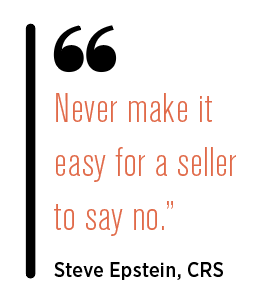
“Your offer is your calling card. How you fill it out and how you package it matters,” Epstein says.
That includes:
- Complete and accurate documentation
- Clear summary of terms as a cover or e-mail
- Proof of funds and solid lender communication
Equally important is understanding the seller’s motivations. “Find out what matters most. Is it time, money or flexibility? Then structure the offer around that,” Epstein advises.
A flexible closing date, leaseback option or simplified terms can sometimes outweigh a higher price.
Creative Deal Design: Negotiation as Architecture
Today’s best agents approach offers like architects. Instead of asking, “What price will win?” they ask, “How can we design a deal that works for everyone?”
That mindset shift is critical.
“You’re the captain of the ship—the lender, the buyer, everyone else is part of the crew,” Rath says.
Agents must:
- Understand financing tools
- Communicate clearly across all parties
- Anticipate potential friction points
- Balance creativity with simplicity
Epstein emphasizes that preparation and research are non-negotiable, urging agents to “do their homework” and demonstrate a clear understanding of the property and process. In other words, creativity without competence doesn’t win deals.
Common Mistakes to Avoid
As offer strategies grow more sophisticated, so do the risks of getting them wrong.
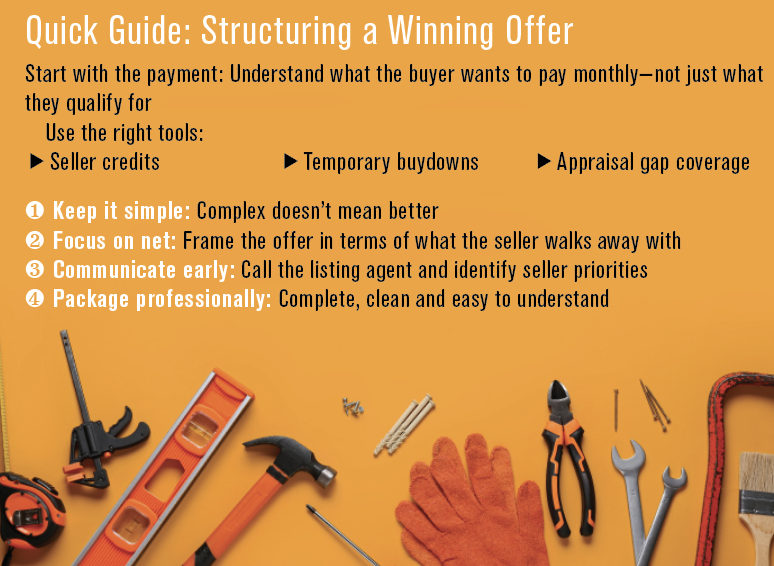
One of the most common missteps is overcomplicating the offer. Creativity can be an advantage, but too many moving parts can confuse sellers, especially when terms like buydowns or layered concessions aren’t clearly explained. When an offer feels complicated, it creates uncertainty and uncertainty often leads to rejection.
Communication is just as critical. Agents who write offers “in a vacuum,” without engaging the listing agent or understanding seller priorities, miss the opportunity to position their client effectively.
Weak financing can also derail an otherwise strong offer. In a market where structure matters as much as price, the financial backing must be clear, credible and complete.
Finally, structure without context falls flat. An offer designed around buyer needs won’t succeed if it ignores what matters most to the seller, whether that’s timing, certainty or net proceeds.
The goal isn’t complexity. It’s clarity and a compelling path to yes.
Strategic Takeaway
As affordability pressures continue, the offer strategy will only become more sophisticated.
The agents who stand out won’t just be skilled negotiators; they’ll be financial translators, capable of designing solutions that align buyer constraints with seller priorities.
“It has to be clear, it has to be strong and it has to look like a done deal,” Rath says.
In a payment-driven market, winning isn’t about offering more. It’s about offering smarter.
Want to hear more from Steve Epstein about creative real estate offer strategies? Check out his episode with us below, and see all episodes of Real Estate Real Talk here.