
Learning how to scale a real estate business starts with identifying the work only you can do—and the tasks someone else could handle more effectively. Before hiring another salesperson, many agents can create greater leverage by strengthening their systems and delegating administrative work.
“The first answer is not always hiring an agent,” says Lisa Spencer, CRS, Broker Associate at LPT Realty and principal consultant at Lisa Spencer Consulting in Plant City, Florida. “Often, it’s delegation.”
Whether through a transaction coordinator, marketing support, trusted lender partner or dependable vendor, the goal is the same: remove work that prevents you from spending time where you create the greatest value—with clients and prospects. The question isn’t simply whether it’s time to build a team. It’s whether doing everything yourself has become the biggest obstacle to growing your business.
Recognize the Signs
Many agents wait until they’re overwhelmed before asking for help. Carl Medford, CRS, CEO of the Medford Real Estate Team with Keller Williams Advisors in Fremont, California, reached that point when his transaction volume exceeded what one person could reasonably manage.
Jeff Wu, CRS, associate broker at Keller Williams Capital Properties in Fairfax, Virginia, encourages agents to recognize the warning signs much sooner.
“When you find yourself and either number one, you don’t have time for things, or number two, you hate doing certain things, then it is time to consider delegating or hiring,” Wu says.
The common thread isn’t transaction count. It’s recognizing when routine tasks begin replacing the work only you can do, such as building relationships, advising clients and generating new business.
Delegate Before You Hire
Recognizing the need for help is only the first step. The harder question is deciding what to let go of and what should always remain your responsibility.
Medford recommends a simple exercise: divide a page into two columns. On one side, write down the work you enjoy and do well. On the other, list everything that drains your energy or keeps you from serving clients. Much of that second list should eventually become someone else’s responsibility.
Spencer calls these the “yellow” activities, in other words, the mechanics of running a business. Preparing listing packets, coordinating inspections, managing paperwork, updating websites and scheduling appointments are essential, but they don’t require the agent’s personal involvement.
Delegating those responsibilities frees agents to focus on lead generation, client consultations and relationship building.
Wu encourages agents to think about delegation through the lens of their individual strengths.
“We all have different gifts,” he says. “Finding things that you truly dislike or aren’t skilled at and hiring out those things allows you to stay in your gifts and the things only you can do.”
For him, that means educating clients, meeting face-to-face with buyers and sellers and strengthening relationships, not installing lockboxes or managing paperwork.
“The dollar per hour of me having lunch with my wife is infinity compared to putting a lockbox on a house,” he says.
Build Systems Before You Build a Team
Delegating can relieve immediate pressure, but Spencer warns against hiring simply because you’re overwhelmed.
“When you hire for relief, you’re setting up your team for failure because you’re not really bringing someone into an established system,” she says. “You’re bringing someone in to rescue you.”
Instead, she recommends creating repeatable processes before adding staff. Buyer presentations, listing consultations, lead generation and transaction management should follow consistent workflows that can be taught and replicated.
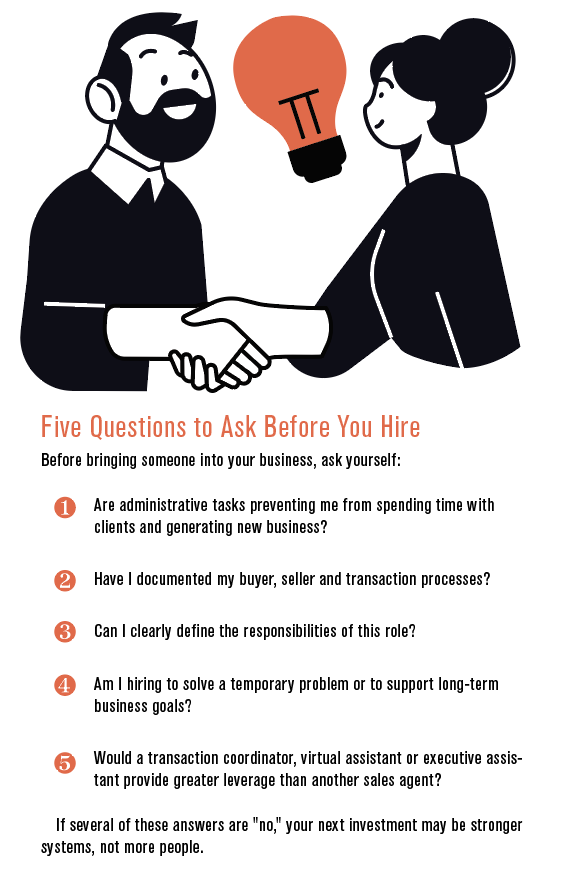
Medford agrees. While many agents assume their first hire should be another salesperson, he believes administrative support almost always delivers greater value.
“They don’t need to hire an agent,” he says. “They need to hire an assistant.”
A capable assistant or transaction coordinator removes administrative bottlenecks, allowing agents to spend more time serving clients and growing their business. Only after those systems are operating smoothly does it make sense to expand sales capacity.
“A lot of agents make the mistake of going out and hiring a buyer’s agent,” Medford says. “Then not only do they have more business than they can handle, they’ve got more nonsense than they can handle as well because there’s nobody running the back office.”
Wu reached the same conclusion through experience. Building reliable administrative support before expanding his sales team ultimately created more leverage than hiring additional agents first.
Leadership Requires a Different Skill Set
Delegation is one thing but leading people is another.
According to Spencer, building a successful team requires a shift from individual producer to leader. Coaching, communication and creating a positive culture become just as important as selling homes.
Medford believes hiring decisions should prioritize character as much as technical ability. Skills can be taught, but trust, integrity and alignment with company values are far more difficult to develop after the fact.
Wu adds that leadership also means establishing healthy boundaries. Early in his career, he accepted appointments whenever clients requested them, believing constant availability was necessary for success. Over time, he realized that well-defined office hours, trusted support and clear expectations actually improved both his client service and his quality of life.
Scale with Intention
Whether an agent delegates a few administrative tasks, hires an assistant or eventually builds a full team, growth should never be driven solely by transaction volume.
Instead, every decision should support three questions:
- Does this improve the client experience?
- Does it free me to focus on the work only I can do?
- Does it help build a sustainable business?
The strongest businesses aren’t built by adding people as quickly as possible. They’re built through thoughtful systems, trusted support and intentional leadership that allow agents to grow without sacrificing service or quality of life.
As Wu reminds agents, “None of that will be on our tombstone.”
Ultimately, success isn’t measured by the size of an organizational chart. It’s measured by building a business that serves clients exceptionally well while creating the life you set out to build.