
In a business increasingly shaped by automation and AI, it’s tempting to think that speed, data and efficiency are what win in real estate. Listings go live in minutes. Buyers arrive with market stats in hand, often knowing the exact houses they want to see before reaching out. AI drafts emails, captions and follow-ups at lightning speed.
And yet, when deals stall, emotions flare, or decisions feel overwhelming, technology takes a back seat, and people do the heavy lifting.
Why is human connection important in real estate?
Human connection is essential in real estate because buying and selling homes involves emotion, trust and complex decision-making. While technology provides data and efficiency, agents build confidence, resolve conflict and guide clients through high-stakes moments.
Empathy Creates Clarity
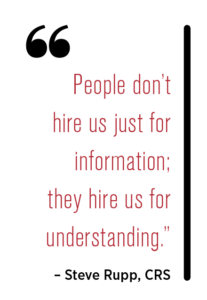
Steve Rupp, CRS, associate broker at Keller Williams Realty in Carmel, Indiana, has spent decades reminding agents that information is no longer the differentiator it once was. With the ease of finding listings, video walk-throughs and local amenities, consumers have access to more data than ever. What they don’t have is context.
Rupp recalls helping a woman sell her late mother’s home. On paper, it was simple. In reality, it was emotionally paralyzing. She resisted pricing the home realistically and struggled with even small staging decisions. Rupp stopped pushing numbers and instead asked whether the price she wanted reflected the home’s value or the value of her relationship with her mother.
That question unlocked the real reason behind her hesitation: grief.
 Once that emotion surfaced and was acknowledged, the deal began to move. The client was able to separate memory from the physical house. Empathy created clarity, and the sale closed because someone understood what was really happening beneath the surface.
Why Tone Matters
As a sales agent at Berkshire Hathaway HomeServices Fox & Roach Realtors in Montclair, New Jersey, Michele Chiles-Hickman, CRS, has built much of her business around moments like that. Moments when conversation and true listening matter more than speed, volume or annual sales totals.
She frequently handles probate sales and family transitions, where emotions run deep, and the stakes are high. In one case, she was helping two sisters sell a shared property. Growing tension between the two brought decision-making to a halt. When one sister became increasingly hesitant and withdrawn, Chiles-Hickman called her instead of escalating the issue via email or paperwork.
“She needed to hear my voice. She needed reassurance,” she explains.
That single conversation changed the tone of the transaction. The sister felt heard, trust was restored and ultimately, the deal moved forward because Chiles-Hickman understood and demonstrated real empathy.
“You can hear anxiety in someone’s voice long before it appears in writing,” she says. “And once you hear it, you know how to respond. That kind of intuition can’t be automated.”
When Empathy Becomes Advocacy
For Alexis Bolin, CRS, associate broker at Keller Williams Gulf Coast, in Pensacola, Florida, empathy often shows up as advocacy, sometimes in ways that extend far beyond the expected scope of the job.
She recalls helping a woman named Miss Barbara, who was nearly 60, buy her first home. Barbara, whose daughter Bolin had previously helped, had been renting a house she was promised she could purchase, only to be told at the last hour that the owner planned to list it publicly. Given 30 days to move out, she called Bolin in tears.
What followed wasn’t a standard transaction. Bolin worked tirelessly with the lender, the seller, and her own commission to make the deal possible. Everyone involved gave up something so Barbara could afford a modest home near the senior center where she felt safe. That deal didn’t just close; it multiplied. Bolin helped Barbara’s granddaughter and grandson with their own real estate needs in later years.
“You can make a sale, or you can make a connection and earn a living for a lifetime,” Bolin says.
Honesty as a Policy
Empathy isn’t always about caring or compassion. Sometimes it’s about knowing how to tell the truth without stripping someone of dignity.
Bolin recalls working with a 90-year-old man who was in no hurry to sell his home and determined to sell it far above market value. Other agents had tried and failed to convince him otherwise. Rather than dismissing him or placating him, she used warmth, humor and honesty to help him face reality on his own terms: “At 90, Mr. Brown, don’t tell me you’re not in any hurry. Let’s face it, Mr. Brown, you can’t even afford to buy green bananas.”
It was that directness that earned his trust. The home sold, and he moved into the retirement community he wanted before decisions were taken out of his hands.
Staying Neutral When Emotions Run High
Associate broker at REMAX Unlimited in Huntsville, Alabama, Tamara Fox, CRS, is unequivocal about one thing: negotiation cannot be automated.
“AI isn’t having the conversations. We are. Negotiation is still a human sport,” Fox says.
Fox recalls representing a divorcing couple selling their former dream home. The transaction required neutrality, sensitivity and constant emotional awareness. She describes her role as “Switzerland”—steady and impartial.
That emotional intelligence preserved trust during one of the most difficult moments of her clients’ lives. Years later, both clients still reach out to her.
Where Technology Ends, Leadership Begins
All four professionals embrace technology in their business models, but none confuse it with human connection.
Rupp uses systems and automation to handle repetitive tasks so he can focus on what matters most: listening deeply and asking better questions. Bolin uses AI creatively for marketing, knowing attention matters, but connection sustains. Chiles-Hickman selectively adopts digital tools while maintaining intentionally personal touches. Fox uses AI as a filter, not a voice.
Across the board, the philosophy is the same: the further a client moves into the transaction, the more human the process must become.
Why Connection Still Closes the Deal in Real Estate
Buying or selling a house is never just about property. It’s about identity, memory, fear and hope. When emotions run high, clients don’t want a system, automation or a robot; they want someone who understands what this moment means to them and their future.
They want someone who will listen longer than necessary, knows when to speak and when not to and who can guide them through complicated decisions.
Technology will continue to evolve and is a crucial part of an agent’s business. But trust is still built the same way it always has: one conversation at a time.
That is the human advantage. And that is why connection still closes the deal.
How to Build Human Connection in Real Estate
- Listen longer than feels necessary; the real motivation often comes later
- Pay attention to tone, pace, and emotion, not just words
- Move important or emotional conversations into real dialogue via a phone call or in-person
- Use technology to support communication, not replace it
- Slow down and choose words carefully when emotions are high
- Tell the truth with care, honesty, and respect
- Ask thoughtful follow-up questions to uncover what truly matters
- Stay steady and neutral during emotionally charged situations
- Build relationships before a transaction is needed
- Act as an advocate, not just a facilitator
- Translate information into understanding and reassurance