
Artificial intelligence is no longer a future concept in real estate. It’s already embedded in how agents write listings, follow up with leads, analyze pricing and communicate with clients. But as adoption accelerates, so do missteps. From overly generic market insights to automation that erodes trust, today’s biggest AI mistakes aren’t technical but rather strategic.
“AI is an incredible tool and should be used with care and responsibility, not left alone and unsupervised—at least not for now,” says Carlos Martell, CRS, associate broker at EXP Realty LLC in Aventura, Florida.
That reality presents both opportunity and risk.
Common AI Missteps in Real Estate
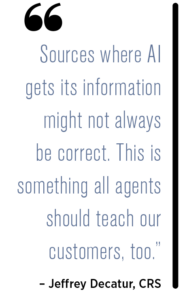 One of the most frequent errors agents make is over-relying on unverified AI output. While AI can generate polished copy in seconds, it often pulls generalized or inaccurate data, which is particularly problematic in a hyper-local, regulation-heavy industry like real estate.
Jeffrey Decatur, CRS, New York RRC State President 2026, and associate broker in Albany, New York, sees this regularly. “AI tends to give national answers, but even two neighborhoods in the same town can operate very differently,” he says. Agents who publish AI-generated market stats or listing descriptions without reviewing them risk sounding misinformed or worse, misleading.
Another common pitfall is automating too much, too quickly. AI tools that text, email or speak with prospects are becoming more sophisticated, but efficiency can quickly come at the expense of authenticity. “If a prospect realizes they’re talking to a robot, they usually hang up, and during this transition period, that loss of trust matters,” Martell notes.
Finally, there’s the mistake of expecting AI to replace the agent entirely, from conversations to negotiations to closing. As Decatur puts it, “AI doesn’t understand nuance, emotion or context the way an experienced agent does. It doesn’t see what you see when you walk through a home.”
Lessons Learned from the Field
Decatur recalls an agent who used AI to write a listing description that praised a “quiet neighborhood filled with natural sunlight” for a property located directly beside active train tracks. The copy sounded impressive, but it described a house that didn’t exist. “That agent didn’t even read what was posted,” Decatur says. “AI pulled keywords it thought mattered, but it didn’t understand reality.”
Martell shares similar experiences with AI writing the wrong data. “I uploaded data for a video script, and the AI read it wrong. I asked it to read it again, and it made the same mistake. Ultimately, it took a few minutes before it got it right.”
Best Practices for Responsible AI Use
Used correctly, AI can be a powerful support system, not a substitute. The most effective agents are applying a few consistent principles:
- Vet everything. Every AI-generated email, post, script or analysis should be reviewed for accuracy, tone and compliance. If you wouldn’t sign your name to it without reading it, don’t publish it.
- Enhance instead of replacing expertise. AI can help outline a listing, summarize a contract or highlight trends. But interpretation, negotiation and judgment still require human experience.
- Know when to step in personally. As AI becomes more prevalent, a genuine human connection becomes a competitive advantage. Agents who are willing to make the call, listen, adjust their script and respond with empathy will stand out.
“For now,” Martell advises, “stick to your imperfect conversations, full of your personality. From the beginning, clients either trust you or they don’t. If they do, you take them to the finish line.”
AI isn’t eliminating the agent. It’s exposing the difference between automation and expertise and rewarding those who understand both.