
In an industry long driven by numbers such as units closed, volume achieved and rankings earned, it’s easy to mistake productivity for performance. But today’s most successful real estate teams are proving a different truth: high performance is intentional, not accidental or purely transactional. It is cultural. And the strongest cultures are built with purpose.
Across brokerages and teams of all sizes, leaders are discovering that sustainable success depends less on chasing KPIs and more on creating environments rooted in trust, clarity and shared purpose. Culture, designed intentionally, becomes a growth strategy rather than a soft concept or afterthought.
Team Culture Is Intentional, Not Accidental
High-functioning teams do not emerge simply because talented agents are placed under the same roof. They are shaped by clear values, psychological safety and a sense of collective purpose. When team members understand not only what is expected but why their work matters, engagement rises, and friction decreases.
As Mark Given, CRS, CRS Certified Instructor, with Mark Given Seminars, LLC, from Roanoke Rapids, North Carolina, emphasizes, culture is built long before results show up on a scoreboard. “It’s something you design, reinforce and protect, especially when things get busy or stressful,” he says.
Teams that prioritize transparency and respect create environments where people feel safe asking questions, sharing ideas and taking calculated risks. That psychological safety fuels accountability and innovation far more effectively than top-down enforcement ever could.
 Redefining Leadership in Real Estate
The role of the team leader has evolved since Given began in the industry over 25 years ago. Today’s most effective leaders are not just managers. They are mentors who develop people. They value empathy as much as efficiency and focus on communication as much as commission.
Given frequently challenges leaders to rethink what authority looks like in modern teams.
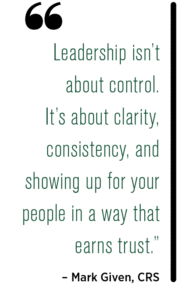
“Leadership isn’t about control,” he says. “It’s about clarity, consistency and showing up for your people in a way that earns trust.”
Rather than directing every move, strong leaders empower agents to own their roles. They offer guidance, feedback and support. This shift from command-and-control to coaching builds loyalty and loyalty drives long-term performance.
Structure and Clarity Drive Collaboration
While culture begins with values, it is sustained through structure. Clearly defined roles, expectations and feedback loops reduce confusion and prevent resentment from taking root. When everyone knows who owns what and how to measure success, collaboration becomes smoother and more productive.
Successful teams build regular communication rhythms into their operations, ensuring feedback is timely, constructive and two-way. Clarity eliminates guesswork and lets agents focus their energy on serving clients rather than navigating internal uncertainty.
Culture That Spans Generations and Work Models
Modern teams span generations and operate across in-office, remote and hybrid environments. Culture can no longer rely on proximity alone, but it must be reinforced intentionally.
Teams that thrive foster inclusion across experience levels, communication styles and work preferences. Technology becomes a connector, not a divider, and leaders remain intentional about engagement no matter where work takes place.
Retention, Burnout and Sustainable Growth
Burnout and turnover remain persistent challenges in real estate, but culture offers a powerful antidote. Teams that prioritize well-being, realistic expectations and mutual support see stronger retention and healthier growth.
A people-first culture does not lower standards—it elevates them. When agents feel valued and supported, productivity follows naturally. Growth becomes sustainable because it is built on human capacity, not exhaustion.
In the end, the most scalable teams are not those that extract the most from their people, but those that invest in them. Culture by design keeps people at the center, allowing teams not only to produce but to truly thrive.