In 2026, buyer confidence in real estate is becoming just as important as interest rates or inventory. Many buyers are financially qualified, but hesitation, uncertainty and decision fatigue are slowing transactions at the point of commitment.
Across markets, agents are seeing a consistent pattern. Buyers are not necessarily priced out. Many are financially qualified. But they are hesitating, pausing mid-search, second-guessing decisions and in some cases, walking away from deals that would have closed just a few years ago.
Morris Lyles, CRS, a real estate agent with ERA Wilder Realty Northeast Office in Columbia, South Carolina, notes that “buyers in 2026 aren’t just cautious. They’re uncertain.” And that uncertainty is showing up at the most critical moment: right before commitment.
Hesitation at the Finish Line
Today’s buyers are asking deeper questions than “Can I afford this?” Increasingly, the question is: “Can I afford this comfortably, and is it the right decision?”
In Tyler, Texas, Jonathan Wolf, CRS, broker-owner at Realty ONE Group Rose, sees this shift firsthand. Buyers are scrutinizing the full monthly payment, including principal, interest, taxes, insurance and lifestyle costs before making a move.
“It’s not just about qualifying anymore; it’s about how it feels month to month,” Wolf explains.
That emotional layer is where deals begin to stall. Even when numbers work on paper, uncertainty creeps in surrounding timing, value and risk.
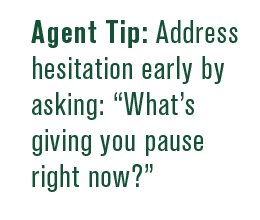
Without clear answers, hesitation builds, delaying decisions.
When Information Becomes Noise
Buyers today are more informed than ever, but not always better informed.
According to Lyles, many buyers are influenced by a wide range of voices, friends, family, social media and headlines, often drowning out their agent’s guidance. This overload creates a paradox as more information leads to less clarity.
It also raises the stakes for agents. As Lyles points out, confidence gaps often emerge when agents haven’t yet established authority. Without that trust, even minor issues—such as small inspection items—can derail a transaction.
Decision Paralysis Is Subtle but Costly
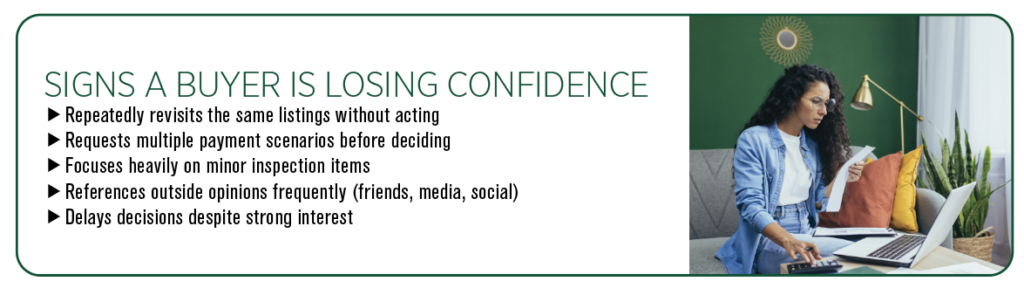
Unlike past downturns, today’s delays are rarely dramatic. Instead, they show up as small shifts in behavior:
- Buyers take longer to decide
- They compare more homes
- They negotiate harder over minor repairs
- They revisit financial assumptions repeatedly
These micro-delays add up, slowing the entire transaction cycle.
In some cases, deals fall apart over issues that would have been considered routine. Lyles notes that transactions are increasingly canceled over relatively minor repairs, costs that, in the broader context, are manageable.
The result is not a stalled market but a more cautious, friction-filled one.
The Emotional Drivers Behind the Numbers
While financial concerns remain central, they are no longer the only factor.
In Lenexa, Kansas, Deb Staley, CRS, associate broker at RE/MAX Realty Suburban, sees hesitation driven by broader anxieties from economic uncertainty to geopolitical concerns.
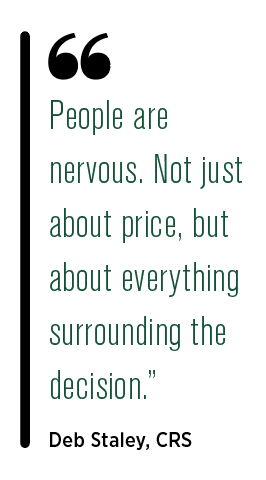
“People are nervous,” she says. “Not just about price, but about everything surrounding the decision.”
For first-time buyers, especially, the emotional weight is significant. Many are entering the market later in life, often without the benefit of prior experience to guide them.
This lack of familiarity amplifies risk perception and slows decision-making.
Rebuilding Confidence: The Agent’s Role
If buyer confidence in real estate, not cost, is the final barrier, then the agent’s role is to restore clarity.
Buyers don’t just need data. They need interpretation.
What effective agents are doing differently:
- Preparing buyers for inspections, repairs and trade-offs before they arise
- Explaining what is typical for a home, neighborhood or price point
- Translating market data into real-world implications
- Sharing graphs and long-term data to ground decisions in reality
- Providing clear recommendations rather than just options
For Staley, one of the most effective tools is simple: showing long-term pricing trends. When buyers see that waiting often leads to higher costs, hesitation can shift into action.
Wolf emphasizes preparation by walking buyers through the process up front so fewer surprises arise later.
And for Lyles, it comes down to experience, knowing the market well enough to normalize what buyers perceive as risks.
The Strategic Takeaway
The 2026 market is not defined by a lack of demand but rather by a gap between ability and confidence.
Buyers are still willing. But they need reassurance, perspective and trust to move forward.
For agents, that means shifting from information providers to decision guides. Because in today’s market, the deal doesn’t fall apart when the numbers stop working. It falls apart when the buyer stops believing they should.